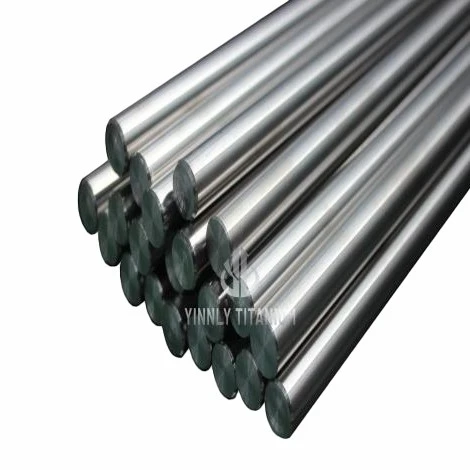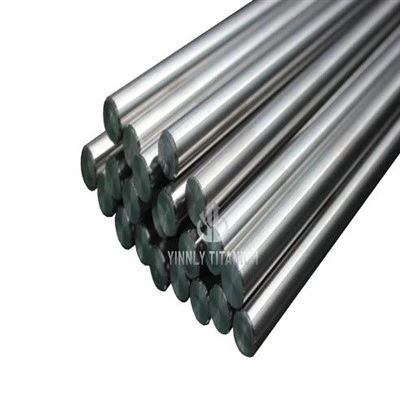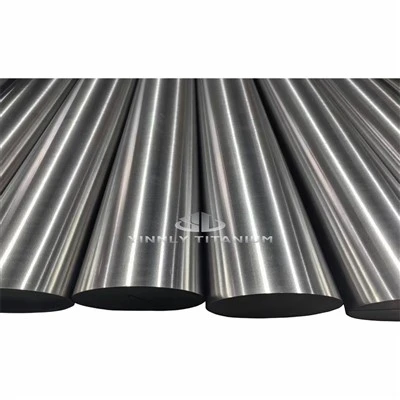

Titanium round bars are cylindrical metallic materials with titanium as the main component. Their existence is based on the specific way titanium is combined and extracted in nature. Titanium exists in the Earth's crust primarily as oxides or silicate minerals, such as rutile or ilmenite. Through metallurgical processes such as the Crohl process or the Hunt process, these minerals are transformed into sponge titanium, which is then smelted into ingots. These ingots are then processed into bars with circular cross-sections through plastic deformation processes such as forging and rolling at high temperatures. This process essentially involves orienting the disordered metallic crystal structure into a regular shape extending along the axial direction of the bar through external force and heat, thereby obtaining the desired geometry and internal fiber flow.
From a microscopic crystal structure perspective, the performance differences of titanium round bars mainly depend on the different arrangements of titanium atoms.
Industrially pure titanium typically exhibits a close-packed hexagonal crystal structure, which provides a certain strength and good corrosion resistance at room temperature. In titanium alloy round bars, the addition of elements such as aluminum, vanadium, and molybdenum can stabilize or introduce a body-centered cubic crystal structure. When these two structures coexist, the material can balance strength and ductility over a wider temperature range. The type of crystal structure, grain size, and uniformity directly determine the ease of dislocation movement under stress, thus affecting its macroscopic mechanical behavior, such as tensile strength, fatigue limit, and fracture toughness.
The corrosion resistance exhibited by titanium round bars does not stem from its chemical inertness, but rather from the dynamic formation and self-healing ability of an extremely thin and dense oxide film on its surface. When exposed to oxygen-containing environments, titanium spontaneously forms an oxide layer primarily composed of titanium dioxide. This film is extremely stable in most oxidizing media, chloride environments, and seawater; even if partially damaged, it can rapidly regenerate under trace amounts of oxygen or moisture. This characteristic allows titanium round bars to maintain structural integrity over long periods in piping systems and ship components involving the transmission of saltwater and chemical media. The effectiveness depends primarily on the specific composition, concentration, and temperature of the environmental medium.
In terms of mechanical load-bearing capacity, the value of titanium round bars lies in their high specific strength and specific stiffness. Their density is approximately 60% that of steel, but their strength can reach the level of some alloy steels. This characteristic means that in applications requiring weight reduction while maintaining load-bearing capacity, such as aerospace frame structures and high-performance sports equipment skeletons, titanium round bars can achieve lightweight structural design. Titanium alloy round bars can maintain creep resistance and fatigue strength within certain temperature ranges, which is crucial for components subjected to prolonged stress and temperature coupling.